

Restaurant Management Software Industry Outlook 2031 Fueled by QSR and FSR Expansion
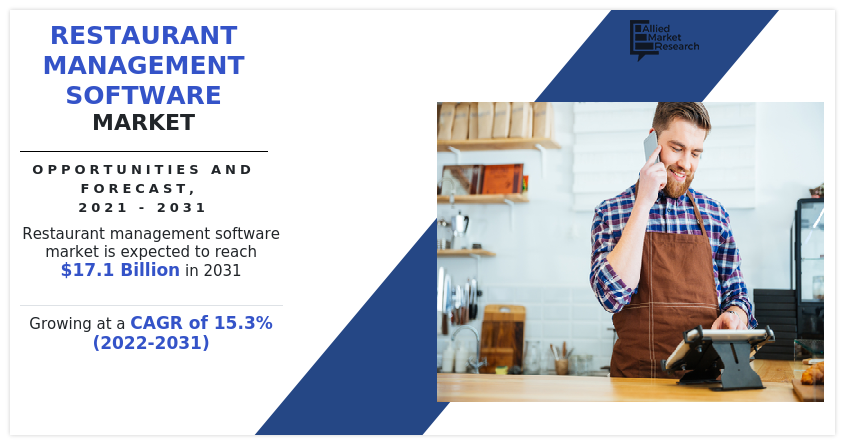
Restaurant Management Software Market projected to witness strong growth through 2031 driven by cloud adoption, automation, and digital restaurant operations.
Growing demand for POS systems, inventory control, workforce management, and digital ordering is accelerating Restaurant Management Software Market growth.”
WILMINGTON, DE, UNITED STATES, June 9, 2026 /EINPresswire.com/ -- — Allied Market Research
The Restaurant Management Software Market is experiencing remarkable growth as restaurants worldwide increasingly adopt digital technologies to streamline operations, improve customer experiences, and maximize profitability. According to recent industry findings, the market was valued at approximately $4.24 billion in 2021 and is projected to reach nearly $17.11 billion by 2031, expanding at a CAGR of 15.3% during the forecast period.
The growing complexity of restaurant operations, combined with changing customer expectations, has encouraged businesses to implement advanced software platforms that manage everything from point-of-sale transactions and inventory tracking to workforce scheduling and customer engagement. As restaurants seek greater operational efficiency and data-driven decision-making capabilities, demand across the Restaurant Management Software Market continues to accelerate.
Download PDF Brochure: https://www.alliedmarketresearch.com/request-sample/A31359
The rise of cloud computing, mobile applications, online ordering, contactless payments, and artificial intelligence is reshaping the food service sector. Restaurants of all sizes are investing in integrated management solutions to maintain competitiveness in an increasingly digital business environment.
Restaurant Management Software Market Overview
The Restaurant Management Software Market encompasses software platforms designed to automate and optimize restaurant operations. These systems integrate various business functions including order processing, inventory management, employee scheduling, accounting, customer relationship management, reporting, and payment processing.
Modern restaurant software solutions have evolved significantly beyond traditional billing systems. Today’s platforms provide comprehensive business intelligence tools that help operators analyze sales patterns, monitor employee productivity, forecast inventory requirements, and enhance customer satisfaction.
Restaurants are increasingly relying on centralized software ecosystems that connect front-of-house and back-of-house operations. Kitchen Display Systems (KDS), digital menus, mobile ordering platforms, and integrated POS systems have become essential components of modern restaurant management strategies.
As restaurant chains expand across multiple locations, centralized management platforms enable operators to maintain consistency, monitor performance, and optimize resource allocation across entire networks.
Restaurant Management Software Market Dynamics
Several factors are driving growth within the Restaurant Management Software Market. Increasing competition among restaurants has created a strong need for operational efficiency and enhanced customer experiences. Restaurant operators are utilizing software solutions to reduce costs, improve service speed, and maximize revenue opportunities.
The growing popularity of digital ordering channels, food delivery services, and omnichannel customer engagement has further strengthened demand. Consumers increasingly expect seamless ordering experiences across online, mobile, and in-store platforms.
Cloud-based deployment models are also transforming the market landscape. Unlike traditional on-premises solutions, cloud platforms offer scalability, lower upfront costs, automatic updates, and remote accessibility. These advantages are encouraging widespread adoption among small and medium-sized restaurants.
However, cybersecurity concerns remain a challenge. Since restaurant management systems process sensitive customer payment data, operators must invest in robust security measures to protect against cyber threats and data breaches.
Despite these challenges, continued innovation and growing digitalization across the food service industry are expected to support long-term market expansion.
Restaurant Management Software Companies Driving Industry Innovation
Leading restaurant management software companies are continuously enhancing their product offerings through technological innovation and strategic partnerships. The competitive landscape includes providers specializing in POS systems, workforce management, inventory control, reservation management, and customer engagement platforms.
Key industry participants include Clover Network, HotSchedules, Jolt, NCR Corporation, OpenTable, Oracle Corporation, Personica, Revel Systems, Square Capital, and TouchBistro. These companies are investing heavily in cloud infrastructure, mobile technologies, AI-powered analytics, and automation capabilities.
Competition among restaurant management software companies is driving product innovation and creating more comprehensive solutions tailored to the unique needs of restaurants. Vendors are increasingly focusing on integrated ecosystems that combine multiple functionalities within a single platform.
As restaurants prioritize digital transformation initiatives, software providers are expected to expand their service portfolios further through acquisitions, partnerships, and new product launches.
Restaurant Reporting Software Enhancing Business Intelligence
Restaurant reporting software has become an essential component of modern restaurant operations. Advanced reporting capabilities allow restaurant managers to gain valuable insights into sales performance, customer behavior, inventory utilization, and labor efficiency.
By analyzing real-time data, operators can identify trends, optimize menu offerings, and make informed business decisions. Detailed reports enable restaurants to track key performance indicators such as average ticket size, peak operating hours, employee productivity, and customer preferences.
Restaurant reporting software also helps management monitor financial performance across multiple locations. Centralized reporting tools provide visibility into revenue streams and operational costs, allowing businesses to improve profitability and resource allocation.
As data-driven decision-making becomes increasingly important, demand for sophisticated reporting and analytics solutions is expected to continue growing across the Restaurant Management Software Market.
Restaurant Management Software Market Segments
The Restaurant Management Software Market can be segmented based on deployment mode, solution type, end-user category, and enterprise size.
By deployment mode, cloud-based solutions dominate the market due to their flexibility, scalability, and cost-effectiveness. Cloud platforms generated the highest revenue in 2021 and are expected to maintain their leadership position throughout the forecast period.
By solution type, purchasing and inventory management solutions accounted for a significant market share. Effective inventory control helps restaurants reduce waste, optimize procurement processes, and improve profit margins.
Front-end solutions, including POS systems and customer engagement platforms, are projected to witness substantial growth. These solutions enhance customer experiences while improving operational efficiency.
By end-user category, institutional dining facilities represented a major market segment, while full-service restaurants are anticipated to experience rapid growth due to increasing investments in digital transformation initiatives.
Restaurant Inventory Management Software Market Size Expands with Demand for Efficiency
The restaurant inventory management software market size is growing rapidly as operators focus on reducing food waste and improving supply chain efficiency. Inventory management solutions provide real-time visibility into stock levels, ingredient usage, and purchasing requirements.
Accurate inventory tracking helps restaurants minimize losses caused by spoilage, overstocking, and theft. Automated inventory systems can generate purchase recommendations, monitor supplier performance, and forecast future demand.
As food costs continue to fluctuate, inventory optimization has become a critical priority for restaurant operators. Software platforms that integrate inventory management with sales data provide valuable insights into menu performance and profitability.
The increasing emphasis on operational efficiency and cost control is expected to drive continued adoption of inventory management software across restaurants worldwide.
Procure This Report (237 Pages PDF with Insights, Charts, Tables, and Figures): https://www.alliedmarketresearch.com/restaurant-management-software-market/purchase-options
Order Management Software Market for Restaurants
Order management software has become a crucial technology investment for restaurants adapting to changing consumer preferences. The rapid growth of online ordering, food delivery services, and mobile applications has increased the need for integrated order management systems.
These solutions streamline order processing across multiple sales channels, ensuring accuracy and reducing operational bottlenecks. Restaurants can manage dine-in, takeaway, curbside pickup, and delivery orders through a unified platform.
Advanced order management systems improve communication between customers, kitchen staff, and delivery personnel. They also help reduce order errors and improve service speed.
As digital ordering continues to gain popularity, demand for sophisticated order management solutions is expected to remain strong throughout the forecast period.
Food Service Management Software Market Trends
The broader food service management software market is benefiting from increasing digitalization across restaurants, cafeterias, catering services, and institutional dining facilities. Organizations are investing in software solutions that improve operational visibility and streamline administrative processes.
Emerging trends include AI-powered forecasting, predictive analytics, contactless payments, mobile workforce management, and customer loyalty platforms. Restaurants are increasingly leveraging technology to enhance customer engagement while reducing operational complexity.
Cloud-native architectures are enabling software vendors to deliver scalable solutions capable of supporting businesses of all sizes. Integration with third-party applications is also becoming a key competitive differentiator.
As the food service industry continues to evolve, technology adoption will remain a primary growth driver.
European Restaurant Management Software Market Outlook
The European Restaurant Management Software Market is expected to witness significant growth during the forecast period. Rising digital adoption among restaurants, increasing demand for automation, and expanding quick-service restaurant networks are supporting regional market development.
Countries across Europe are investing in digital infrastructure and encouraging businesses to modernize operations through technology adoption. Cloud-based solutions are gaining popularity due to their affordability and ease of implementation.
The European restaurant management software market is also benefiting from growing consumer demand for contactless services, mobile ordering, and personalized dining experiences. Software vendors are responding by developing solutions tailored to regional regulatory and operational requirements.
As digital transformation accelerates across Europe, the region is expected to emerge as one of the fastest-growing markets globally.
Restaurant Market Research and Business Intelligence
Restaurant market research has become increasingly important for operators seeking to understand customer preferences and industry trends. Advanced software platforms collect valuable data that supports strategic planning and competitive positioning.
Restaurants can analyze customer demographics, purchasing behavior, menu performance, and seasonal demand fluctuations. These insights enable businesses to optimize marketing campaigns and improve customer retention.
Business intelligence tools are helping restaurant operators navigate an increasingly competitive marketplace. Access to real-time analytics allows managers to make informed decisions that enhance profitability and operational efficiency.
The integration of market research capabilities into restaurant management platforms is expected to become increasingly common in the coming years.
Competitive Landscape
The Restaurant Management Software Market remains highly competitive, with technology providers focusing on innovation, product enhancement, and strategic collaborations. Market participants are developing integrated platforms that combine POS systems, inventory management, workforce scheduling, analytics, and customer engagement tools.
Companies are increasingly investing in artificial intelligence, machine learning, and cloud computing technologies to differentiate their offerings. Strategic acquisitions and partnerships continue to reshape the competitive landscape.
As demand for comprehensive restaurant management solutions grows, competition among vendors is expected to intensify, driving further innovation and product development.
Future Outlook
The future of the Restaurant Management Software Market appears highly promising. Continued digital transformation across the food service industry will create significant opportunities for software vendors and technology providers.
Emerging technologies such as AI, predictive analytics, IoT-enabled kitchen equipment, voice ordering, and advanced customer engagement platforms are expected to redefine restaurant operations. Growing demand for cloud-based solutions and integrated management platforms will further support market expansion.
Restaurants increasingly recognize technology as a strategic investment rather than an operational expense. This shift in perception is expected to accelerate software adoption across both independent establishments and large restaurant chains.
Get a Customized Research Report: https://www.alliedmarketresearch.com/request-for-customization/A31359
Conclusion
The Restaurant Management Software Market is entering a period of sustained growth driven by digital transformation, cloud adoption, operational automation, and evolving customer expectations. With the market projected to increase from $4.24 billion in 2021 to more than $17.11 billion by 2031, technology will continue to play a central role in shaping the future of restaurant operations.
Growing demand for inventory management, workforce scheduling, reporting analytics, order management, and customer engagement solutions is creating substantial opportunities for software providers worldwide. As restaurants increasingly embrace digital innovation, the Restaurant Management Software Market is expected to remain one of the fastest-growing segments within the broader hospitality technology industry.
Trending Reports in Energy and Power Industry:
AgriTech Market
https://www.alliedmarketresearch.com/agritech-market-A128653
Storage Management Software Market
https://www.alliedmarketresearch.com/storage-management-software-market-A115204
Speech-to-Text API Market
https://www.alliedmarketresearch.com/speech-to-text-api-market-A09527
Spain Time And Attendance Software Market
https://www.alliedmarketresearch.com/spain-time-and-attendance-software-market-A255477
Optical Character Recognition Market
https://www.alliedmarketresearch.com/optical-character-recognition-market-A09520
Spatial Computing Market
https://www.alliedmarketresearch.com/spatial-computing-market-A202233
Sales Training Software Market
https://www.alliedmarketresearch.com/sales-training-software-market-A325805
About Us
Allied Market Research (AMR) is a full-service market research and business-consulting wing of Allied Analytics LLP based in Portland, Oregon. Allied Market Research provides global enterprises as well as medium and small businesses with unmatched quality of "Market Research Reports" and "Business Intelligence Solutions." AMR has a targeted view to provide business insights and consulting to assist its clients to make strategic business decisions and achieve sustainable growth in their respective market domain.
Pawan Kumar, the CEO of Allied Market Research, is leading the organization toward providing high-quality data and insights. We are in professional corporate relations with various companies and this helps us in digging out market data that helps us generate accurate research data tables and confirms utmost accuracy in our market forecasting. Each and every data presented in the reports published by us is extracted through primary interviews with top officials from leading companies of domain concerned. Our secondary data procurement methodology includes deep online and offline research and discussion with knowledgeable professionals and analysts in the industry.
David Correa
Allied Market Research
+ + + + + + + + + + + + + +1 800-792-5285
email us here
Visit us on social media:
LinkedIn
Facebook
YouTube
X
Legal Disclaimer:
EIN Presswire provides this news content "as is" without warranty of any kind. We do not accept any responsibility or liability for the accuracy, content, images, videos, licenses, completeness, legality, or reliability of the information contained in this article. If you have any complaints or copyright issues related to this article, kindly contact the author above.
